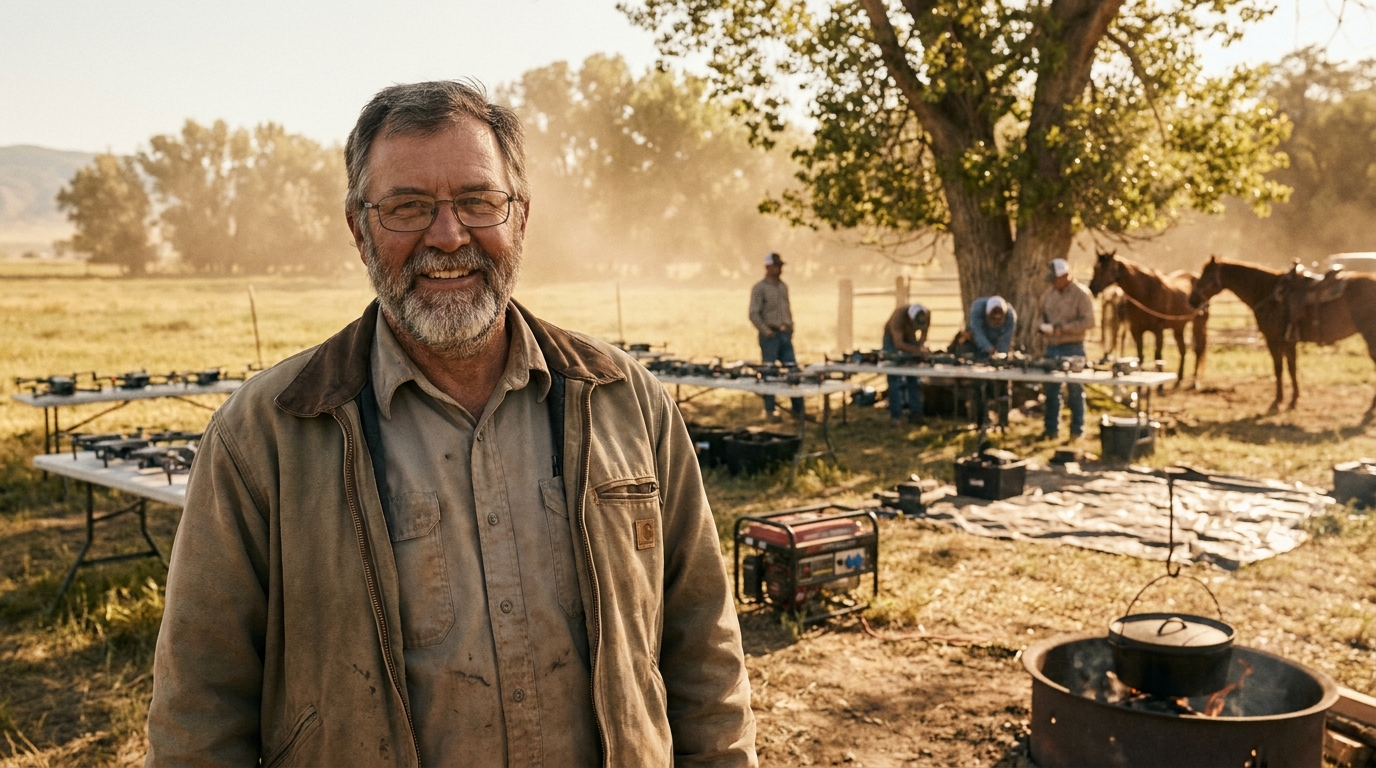
The Sanpete Agricultural Drone Co-op runs a branding day every spring — first Saturday after the bishop's storehouse finishes its spring rotation, which usually puts it in early June. This year it landed on the sixth. Forty-three drones to brand, eight farms represented, fourteen volunteers in the corral, and one very large dutch oven of peach cobbler.
People ask me what branding actually is in this line of work. The short answer: it's serial registration, ownership marking, and theft deterrence, in that order. The long answer is the rest of this post.
When you run agricultural drones for a living — and a lot of the bigger operators around here do, because hand-walking a sixty-acre field for crop assessment isn't economically feasible anymore — you wind up with a lot of expensive equipment moving between a lot of properties. You loan birds to neighbors. You sell used birds at auction. You have hands who fly your birds and sometimes those hands change jobs. Birds get lost. Birds get stolen. Birds get found in places they shouldn't have been found. The branding day exists because somebody needed a clear, durable, tamper-evident way to say this drone belongs to this person, registered on this date, with this serial, witnessed by these neighbors. A paper title isn't enough. A serial number on the underside isn't enough — a thief can grind that off in thirty seconds. A heat-stamp on the airframe is enough.
Here's how the day runs.
We start at six in the morning at the co-op pasture south of town, which is the same pasture where the old livestock auction used to run before they moved it out to Ephraim. Volunteers show up at six with their drones — usually loaded in plastic tubs or foam-lined cases — and we work them through a registration table first. Mary Beth Harker runs the registration table. She has been the secretary of the co-op for nineteen years and she is incorruptible. You hand her your drone, your photo ID, and a printed-out invoice or bill of sale proving you own it. She enters the serial number, the model, your name, the date, and your designated brand mark into a notebook — a physical paper notebook — and then into a backup spreadsheet on a laptop she keeps in a Pelican case. Mary Beth does not trust the cloud. Mary Beth has reasons.
Each member of the co-op has a registered brand. Most of them are inherited from the family cattle brand — my brand is a lazy A bar, which was the brand my great-grandfather Heber Ashton registered with the Utah territorial brand office in 1872 and has been continuously held by the Ashton family since. We brand drones with the same mark we'd brand a calf with, because that's the mark the brand book recognizes, and because the brand book is what holds up in court when somebody disputes ownership. The fact that the mark is going on a piece of plastic instead of a steer's hide does not change the legal weight of the mark. The brand book doesn't care what surface you put it on. It cares whose mark it is.
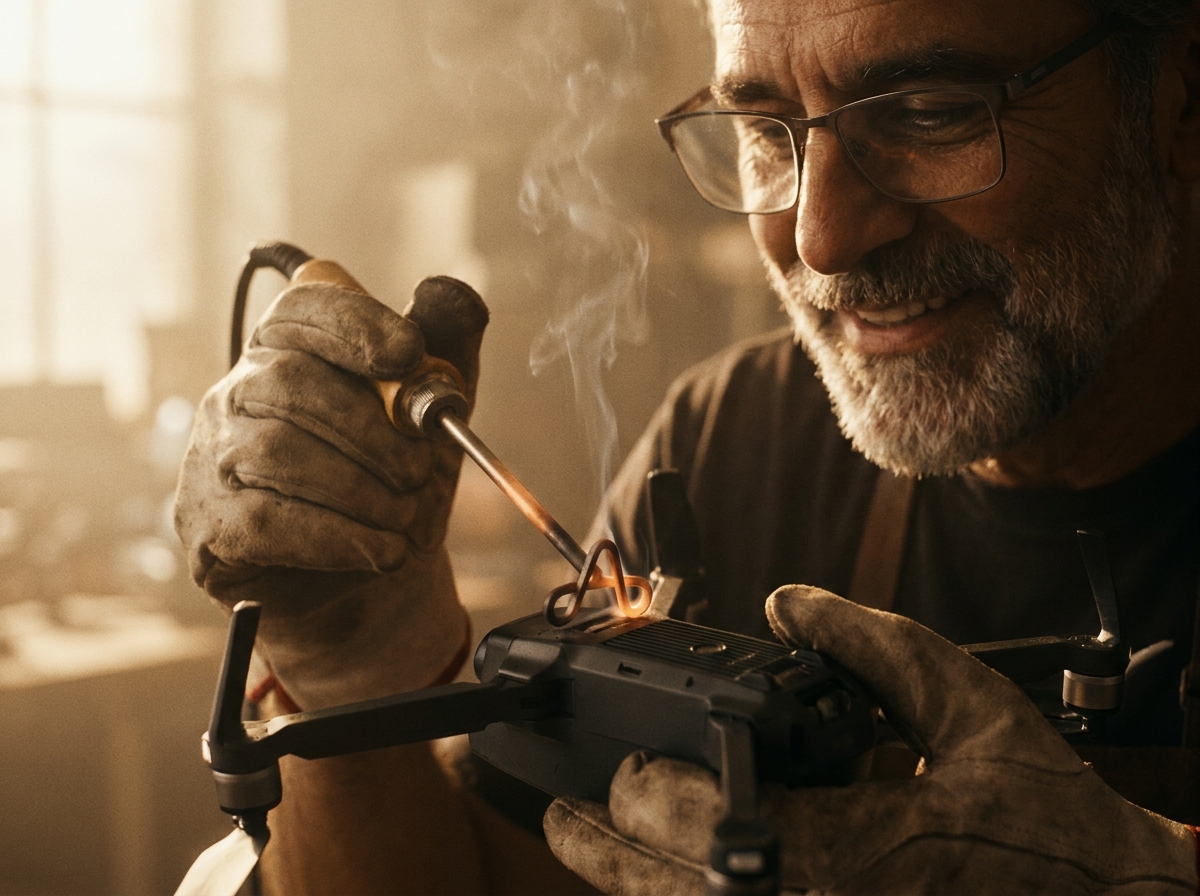
Branding the drone itself is a job for two people — one to hold the bird steady, one to apply the heat stamp. We use a small handheld induction-heat brand iron that we run off a portable generator. The iron is the same shape and size as the cattle iron, but with a thin tip that's calibrated to apply heat for exactly four seconds at a specific temperature that's hot enough to fuse the brand into the polymer of the drone's housing without compromising the structural integrity of the frame. You apply the iron to a specific spot on the underside of the airframe — same spot for every drone, so brand inspectors know where to look — and you hold it for the count of four. You hear a quiet hiss. You smell something a little plasticky. You pull the iron and there's your brand, recessed about half a millimeter into the polymer, durable to the lifespan of the drone, undisturbable without obvious tampering.
After the brand goes on, the drone goes through a final station where a witness — usually a neighbor or another co-op member — signs the registration as having seen the brand applied. That witness signature is what makes the registration enforceable. You can dispute a serial number. You can dispute a paper title. You cannot dispute three other ranchers swearing in writing that they watched the brand go on at a specific time and place. The witness signature is the load-bearing piece of the whole system.
We did forty-three birds yesterday. The biggest fleet was Mark Hansen's — he runs a forty-bird ag operation up by Fairview, monitoring alfalfa and a small dairy herd — and he brought thirty-eight of them in for branding all at once. He has not bothered to brand his birds in two years because he hadn't lost any. Then he lost three to a hand who didn't come back to work after the spring planting. He filed a report, the birds turned up at an auction in Provo, and he got them back — but only because he could prove ownership with the witness signatures from the last branding day in 2024. He came in this year with thirty-eight birds and a wallet of cash for the branding fees and said he wasn't going to skip another year.
Mark's son, who is fourteen and is one of the kids I'd taught at UAV camp two summers ago, ran the brand iron for his father's fleet himself. I watched him do the first three and then I left him to it. He's good. Steady hand. Knows when to pull. He'll be running ag drones of his own inside of five years.
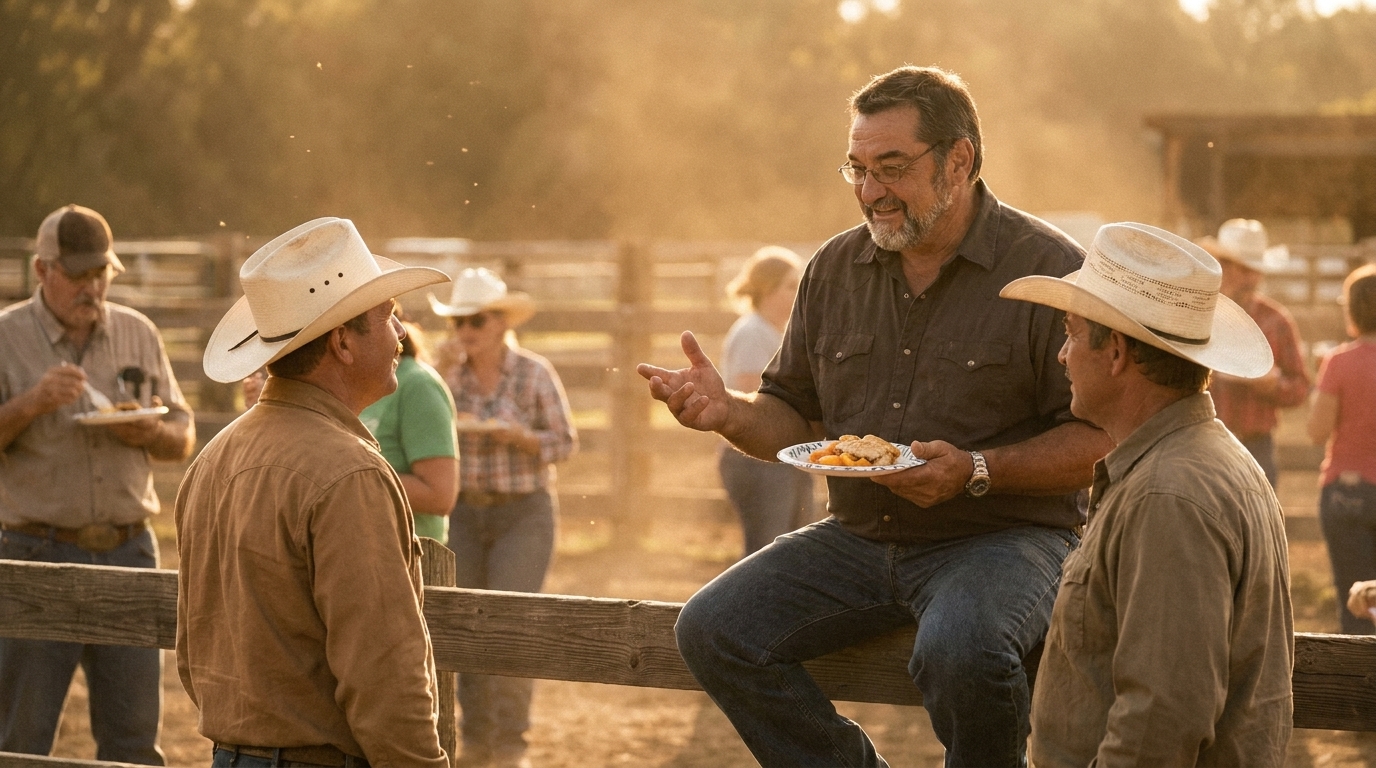
We broke for lunch at noon. Sister Hansen had brought up two five-gallon dutch ovens full of peach cobbler — I do not know how she gets cobbler to retain its texture in a five-gallon dutch oven, but she does — and somebody had brought a tray of pulled pork, and somebody else had brought a sheet pan of rolls from Pyper's. We ate sitting on the corral fence and on overturned drone crates and on the tailgate of Mark's truck. Bishop Hansen — the actual bishop, not the dutch oven matriarch — said grace over the food. We all took our hats off.
We finished the last bird by three. The volunteers swept the pasture, packed the iron, locked up the gen-set, and headed home. Mary Beth's notebook went into the co-op safe. The backup spreadsheet went onto a USB drive that she keeps in a different safe in a different building in a different town. Mary Beth has reasons.
That's branding day. That's the calendar. We do it again next year.