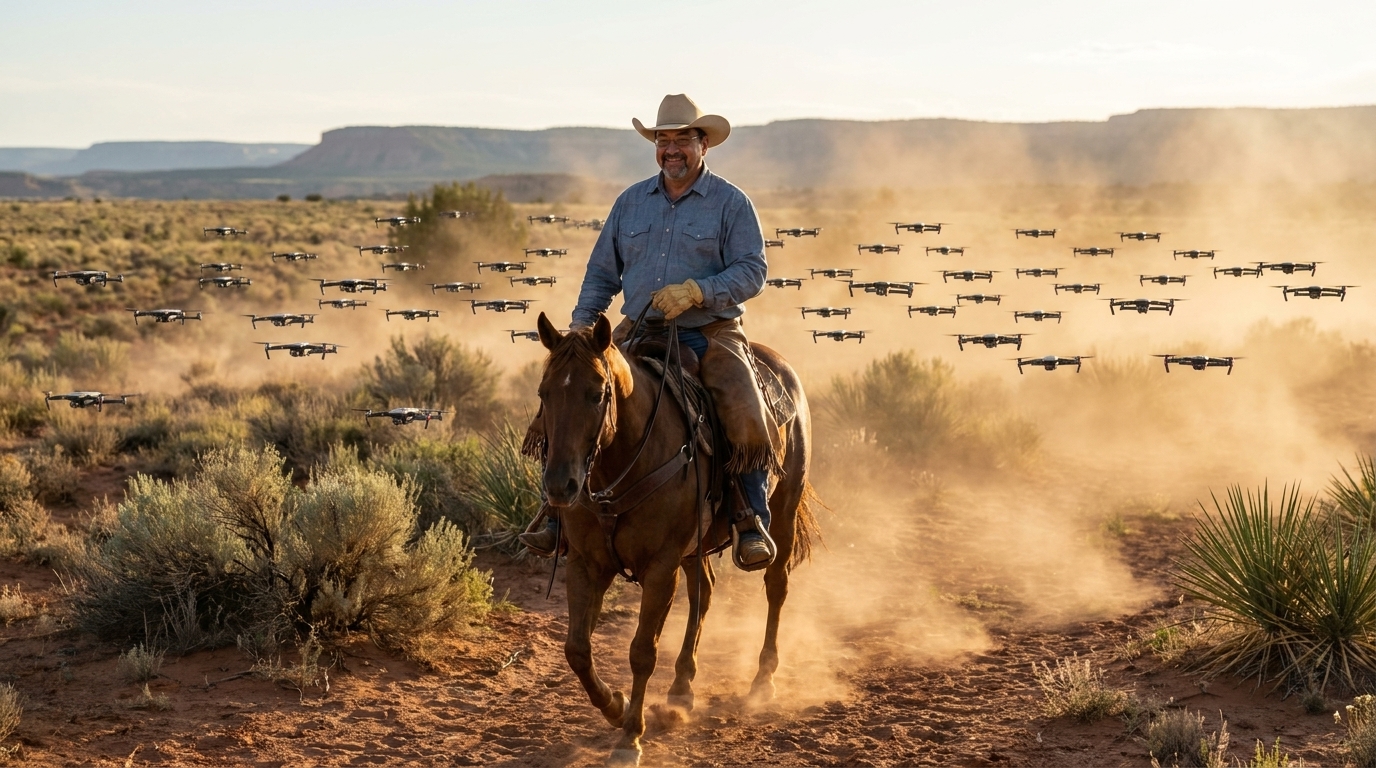
A spring herd · sage and red dirt · the old route through Holden
Six lines of work, one shop, one phone. Most folks call for one and end up needing two. The first call is on me.
Catching, herding, and managing the day-to-day behavior of your fleet — whether you've got two birds or two hundred.
Most fleets aren't lost. Most fleets are just being run a little harder than they were built for, by somebody who learned to fly from a manual and never learned to read a herd. The difference between a fleet that flies its second year and one that doesn't is usually somebody paying attention to the small things — the battery cycles, the gimbal calibrations, the firmware drift, the wind on Tuesday afternoons when the canyon empties out and nobody's expecting it.
What that looks like in practice: I come out, I sit with your operator for a day, I read your books. I tell you what's about to break and what isn't. I write it up. If you want me to keep handling the fleet on retainer, I can do that. If you want me to set you up so you can run it yourself with one weekly check, I can do that too. Whichever costs you less.
Quoted by fleet size and retainer cadence. Standalone day rates also available.
Lost a bird in a river bottom. Stolen out of a barn. Drifted into a canyon and didn't come back. I'll find it. Most birds come home.
Recovery work is the quietest work I do, and the closest to the old work. You don't herd anything. You don't manage anything. You just sit on a horse with a tracking antenna and a piece of paper and you read the ground until the ground tells you where the bird is.
Modern birds — most of them — still broadcast a faint position beacon on a separate channel from the main flight radio for somewhere between forty and a hundred and twenty hours after they go down. I have the equipment to listen to that beacon and to triangulate against it from two or three bearings. I have a horse that will go quietly through willow brush taller than my head without complaining. Between those two things, most birds come home.
For stolen birds, the work is different. That's brand verification, co-op records, sometimes a call to the brand inspector's office. Mary Beth Harker has been the secretary of the Sanpete co-op for nineteen years and she is the reason most of those birds come back.
Flat day rate plus mileage on long-distance recoveries. Insurance liaison available if asked.
Heat-stamp brand application, witness signatures, co-op registration. The same brand book my great-grandfather Heber registered with the Utah territorial brand office in 1872 still holds up today.
The mark goes on the underside of the airframe — same spot for every drone, so brand inspectors know where to look — and it goes on with a small handheld induction-heat brand iron that fuses the mark into the polymer of the housing without touching the structural integrity of the frame. You hear a quiet hiss. You smell something a little plasticky. You pull the iron and there's your brand, recessed into the polymer, durable to the lifespan of the bird, undisturbable without obvious tampering.
After the brand goes on, the registration goes into Mary Beth's notebook — the physical paper notebook, witnessed by a third party — and into the backup spreadsheet, which lives on a USB drive in a different safe in a different building in a different town. Mary Beth does not trust the cloud. Mary Beth has reasons.
That witness-signed paper registration is what makes a brand enforceable. You can dispute a serial number. You can dispute a paper title. You cannot dispute three other ranchers swearing in writing that they watched the brand go on at a specific time and place. That signature is the load-bearing piece of the whole system.
Branding day runs first Saturday after the bishop's storehouse spring rotation. Individual branding by appointment.
Four days, ages 9 through 14. Day one is rope. Day two is rope and drone. Day three is the controller. Day four is the drive.
The premise is simple. You cannot wrangle what you cannot catch, and you cannot catch what you cannot rope, and you cannot rope what you cannot loop, and you cannot loop a rope if you've never held one before. Rope first. Everything after.
We run one session in June and one session in August, twelve kids per session. Half the slots go to the Snow College summer rec program. The other half are open to local kids and any out-of-area kid whose parents can get them to Mount Pleasant for the week. Lunch is provided. Sister Hansen brings the pie. There is no other option for dessert.
If your kid finishes camp and wants more, I run Saturdays out of my home pasture through the fall. Free, with a parent's consent.
$350 per kid per session. Two scholarship slots reserved each session.
Mount Pleasant to Vegas. Salt Lake to Denver. Albuquerque twice. Long-distance fleet relocation by horseback and ground crew, no bird left behind.
You'd be surprised how often somebody needs to move a hundred drones from one place to another without putting them all in the back of a box truck and hoping. The reason is usually the same: a box truck is a single point of failure. A drive is a hundred points of failure, distributed across a herd that's already moving, and any one of them can fail without breaking the rest. That's worth something. It's worth more than the drive itself costs.
Standard drive crew: me, my brother-in-law Royce, my hand Travis, and a follow-truck driver. We do daylight only — no night drives, period — and we take the old wagon routes whenever the modern road allows it. Drive duration depends on herd size and weather, but four days for two hundred birds across five hundred miles is a reasonable benchmark.
Quoted per herd size, distance, and crew configuration. Insurance coverage included.
Fleet structure. Airspace etiquette. Where to keep your birds when the wind comes up out of the south.
This is where most of the work that matters happens, and it's the work I bill the least for. Somebody calls because they think they need a drive, and we end up talking for forty minutes about how their fleet is being run, and at the end of it they don't need a drive at all — they need to fire their operator and hire two new ones, or they need to consolidate two fleets into one, or they need to stop running birds in the canyon on Tuesday afternoons.
I'll take the call. I'll tell you what I think. If I'm not the right person for whatever you actually need, I'll tell you that too, and I'll send you to somebody who is. Honest counsel is the cheapest thing I sell and the most valuable.
First call free. Hourly thereafter. No retainer required.
Most first conversations are a fifteen-minute call to figure out what you actually need. No pitch on the first call.