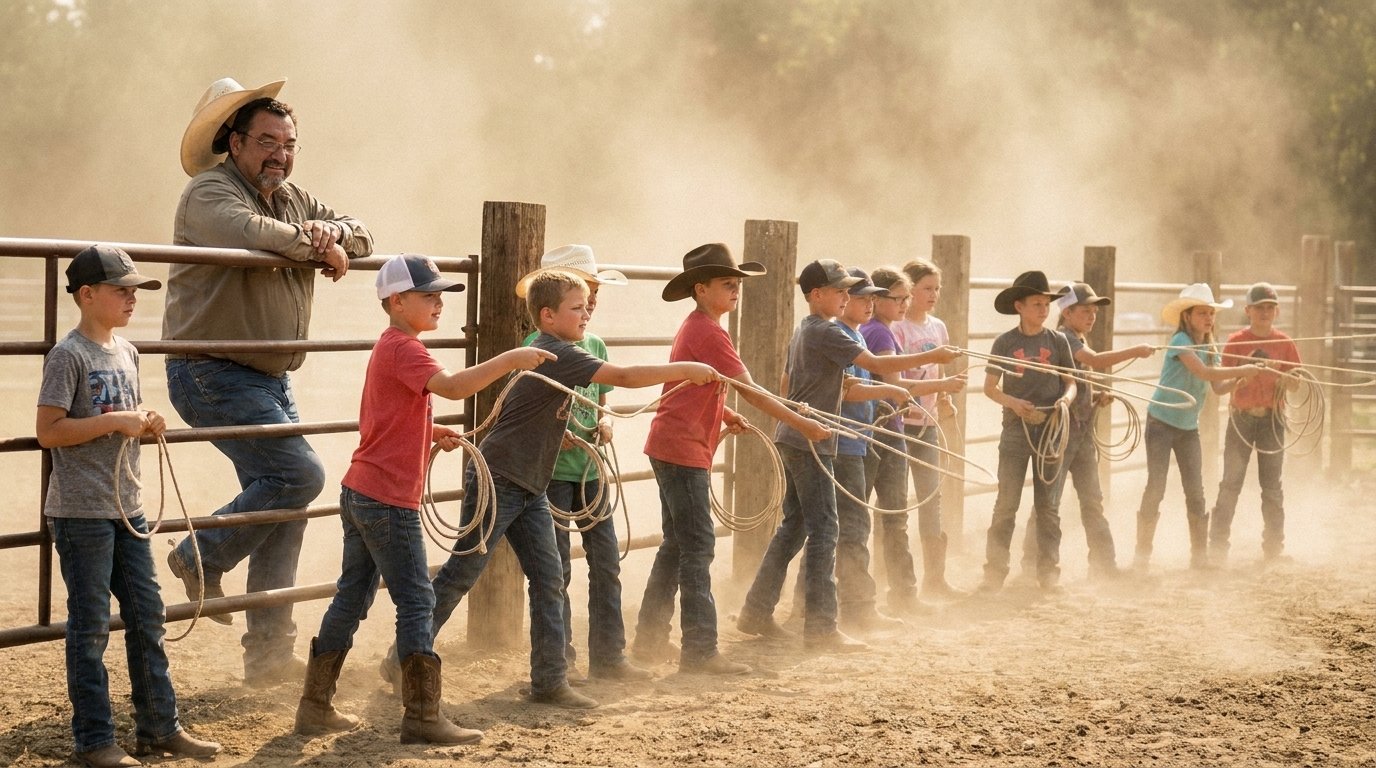
We ran the first session of UAV camp last week. Twelve kids, ages nine through fourteen, four days, dawn to dinner. Most of them came down from the Snow College summer rec program — Snow runs an outdoor youth thing every June and they sent a van full of kids over to my place on the agreement that I'd send them back tired and not hospitalized. I think we just about met both of those.
Day one is rope. Just rope. I tell the kids the first morning that we aren't going to fly anything, we aren't going to touch a controller, we aren't going to look at a drone for the entire day. The disappointment in their faces is the first thing I'm going to fix. The reason is simple: you can't wrangle what you can't catch, and you can't catch what you can't rope, and you can't rope what you can't loop, and you can't loop a rope if you've never held one before. Rope first. Everything after.
I have them out behind the barn at seven-thirty in the morning with twelve lengths of soft-laid sash cord — they aren't strong enough yet for a real hard-twist lariat — and I have them tie knots. Bowline. Clove hitch. Honda knot, which is the one that makes the loop slide. By ten in the morning every one of them can tie a honda blindfolded. By noon I have them throwing the loop at a wooden fence post. By the afternoon I have them throwing at a hay bale. By dinner I have them throwing at a hay bale that I'm slowly walking across the corral. Every kid lands the rope on the bale at least once by dinner on day one or they don't get pie, and Sister Hansen up the road makes the pie for camp every year, and there is no force in heaven or on the high plains that will make a child miss her sour cream raisin pie. Every kid lands the rope.
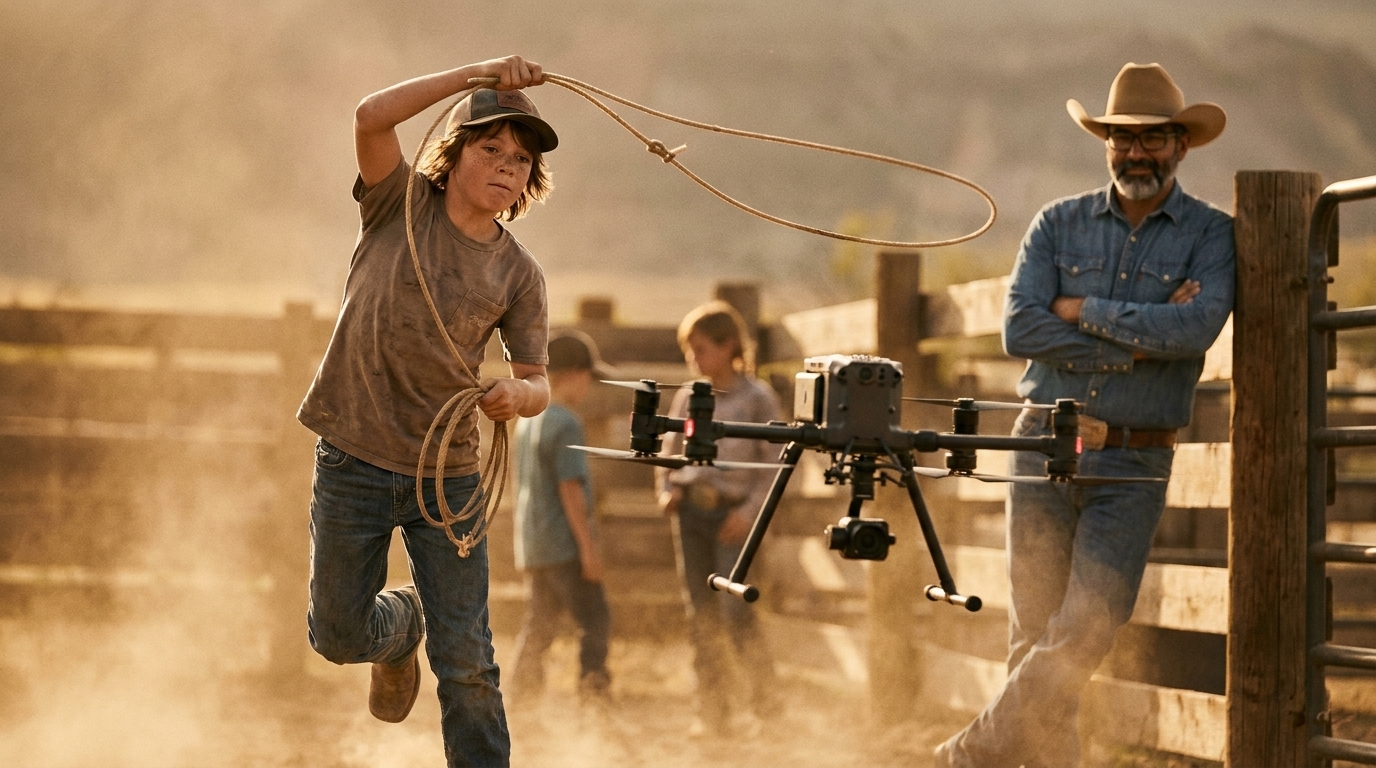
Day two is rope and drone. They don't fly the drone — I fly the drone, a slow heavy Matrice 30T with extra batteries in it that I picked up specifically for camp because it hovers like a brick — and they throw rope at it. I bring it up to about eight feet, slow it down to a hover, and walk it across the corral while the kids stand in a line and throw the loop at it as it passes. The first few hours they miss every single time. By midmorning they're catching it about one throw in twenty. By noon I'm dropping the altitude to six feet to keep it sporting and they're catching it one in ten. By dinner one of the boys — a quiet kid from Manti named Trent, twelve years old, didn't say much the whole first day — Trent is catching it three throws in five and looking at me with this look like he isn't sure if he should be proud or embarrassed. I tell him he should be both. That's the right ratio for a roper.
Day three is the controller. Now we open up the controllers. They have all watched me fly for two days. They know how the drone moves. They know how it responds to a throttle nudge. So when they get the controllers in their own hands, I don't have to teach them how to fly. I just have to teach them how to fly thoughtfully. I teach them what a wind reading is. I teach them how to read the LED lights to tell if a bird is healthy or has a battery flag. I teach them what to do if you lose video signal but still have control. I teach them what to do if you lose both. I teach them the prayer my granddad taught me, which is what you say under your breath when the bird won't respond. I don't make them say it. I just tell them what it is, and tell them when I say it, and tell them when my granddad said it, and let them choose what they do with that.
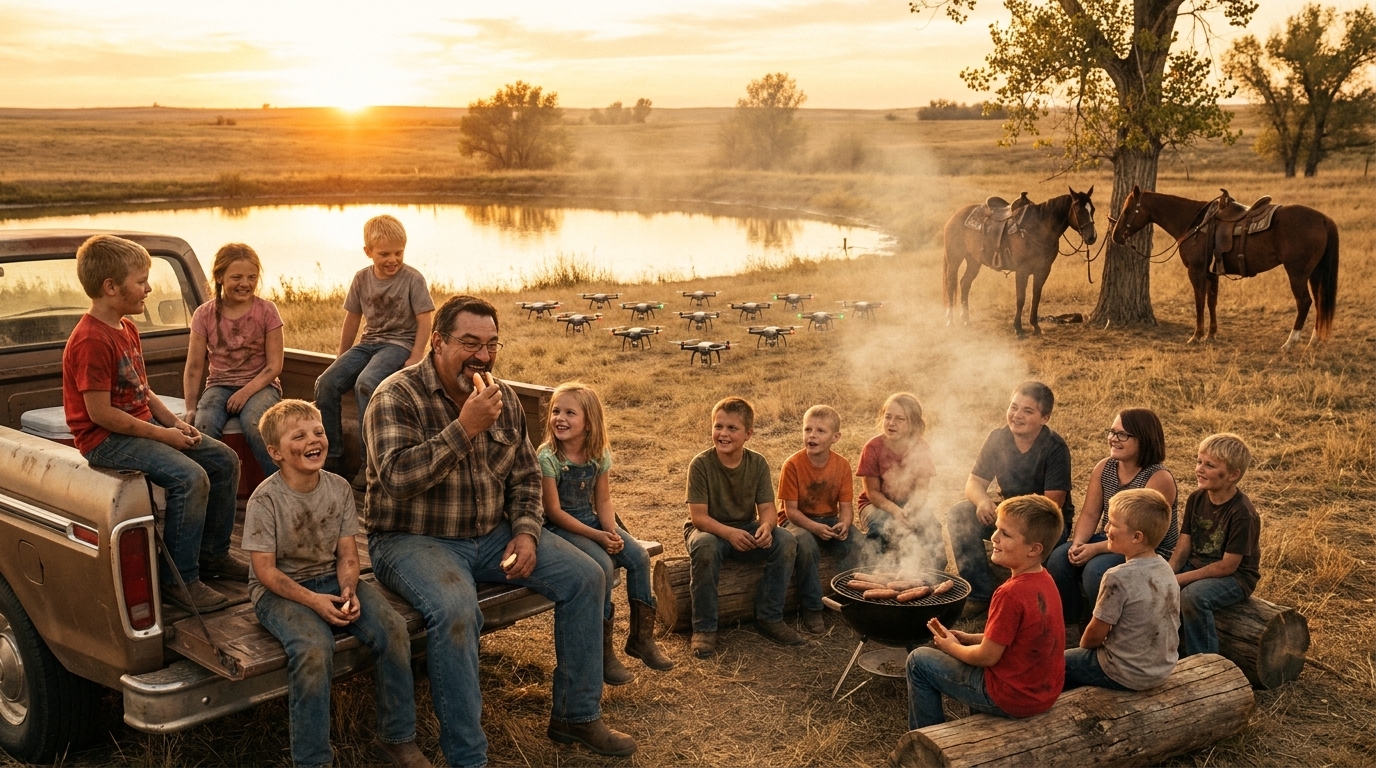
Day four is the drive. The actual drive. We take all twelve kids, mounted on horses I've borrowed from neighbors — every kid in Sanpete County rides by the time they're seven, so I don't have to teach that part — and we move a small herd of fifteen training drones from my home pasture out through the cottonwoods and down to a small pond half a mile away. Each kid takes a turn on point. Each kid takes a turn on swing. Each kid takes a turn on drag. By the time we get to the pond, every kid in camp has been responsible at some point for keeping the herd honest. They have all lost the herd at some point during the drive. They have all gotten it back. That's the lesson.
We have dinner at the pond. We cook hot dogs on a grill I haul out there in the truck. Sister Hansen brings the pie. I read them a passage I always read at the end of camp — it's from the journal of one of my own ancestors who came across the plains in 1851, a man named Heber Ashton, who wrote a line in his trail journal that I keep on the wall of the barn:
"We drove the cattle, but we did not herd them. We pointed them toward the place where the Lord meant them to go, and we asked Him to keep our hand steady, and we let the cattle move themselves."
That's the whole thing right there. You don't herd. You point. You ask. You let them move.
The kids climb into the van around six-thirty. They are filthy. They smell like horse and dust and burnt hot dog. Two of them are already asleep before the van pulls out of the gate. I told the Snow College director when she came to pick them up that I'd send them back tired and not hospitalized and she looked at the kids and at the van and at me and she said, "You held up your end."
Trent's parents called me three days later. They want to enroll him in fall camp. I told them fall camp doesn't exist but if Trent wants to come out on Saturdays and ride with me, he can. He's coming this Saturday. I'm going to teach him the longer throw.
That's UAV camp. That's the work.