Some jobs you take because they pay. Some you take because they're funny. The Salt Lake run was both.
A commercial outfit out of Park City — won't name them but they do construction-progress surveys for big developers — had one of their commercial fixed-wing drones go off course Wednesday afternoon during a survey of a job site near the Union Pacific yards. The bird was a Wingtra Gen II, which is not your hobby toy. It's a vertical-takeoff fixed-wing the size of a small kitchen table, and it costs about thirty-five thousand dollars, and it does not respond well to losing GPS lock over a major rail yard.
What it did was climb. It climbed up to about four hundred feet and then it just started drifting east. Slow. Steady. About twelve knots. East. By the time their pilot got me on the phone the bird was already over downtown Salt Lake somewhere around the Salt Palace and they had lost control link entirely. The pilot was panicking. He said he'd seen it last on a parking-lot security feed somebody had sent him over text, and the bird was just orbiting low over the Gallivan Center plaza like it had decided it lived there now.
I asked him: "Do you want it grounded, or do you want it back in one piece?"
He said: "Back in one piece. It has client footage on the card. I cannot lose the card."
I said: "Then I need to bring Bishop."
There was a long pause on the other end of the phone.
He said: "Your horse?"
I said: "My horse."
I'll tell you why. A commercial fixed-wing in a slow autonomous orbit is doing about twelve to fifteen knots. That's just about a horse's lope. A man on foot with a rope can't keep pace with a drone like that for more than thirty seconds. A man in a vehicle can't get close enough to it without hitting a building, a pedestrian, or a TRAX line. A man on a horse — who can move at the same speed as the drone and turn on a dime — can stay underneath it for as long as the drone is in the air. The horse is the right tool. People forget that.
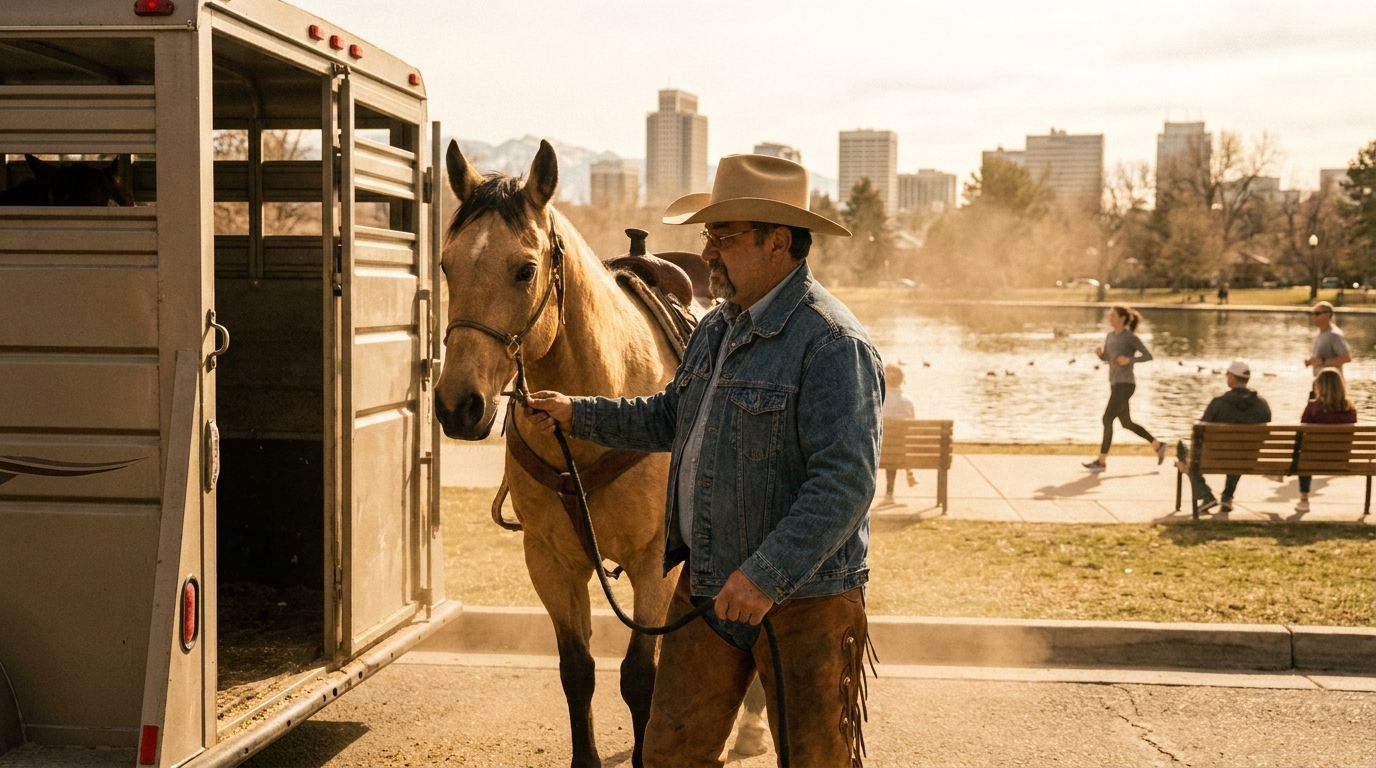
I trailered Bishop up I-15 and pulled into Liberty Park about an hour and forty minutes after the call. I unloaded him by the duck pond on the east side. There were maybe twenty people in the park having lunch. They watched a man in a tan Stetson unload a buckskin gelding out of a horse trailer onto the grass next to a city pond and not one of them said a word. Salt Lake people see worse on a Tuesday.
I rode Bishop out the north gate of Liberty Park, crossed 700 South at a walk, and headed up 600 East toward downtown. I got pulled over by a Salt Lake PD officer about three blocks in. She asked me if I knew that horses were not technically prohibited but were also not technically encouraged on city streets. I said yes ma'am. She asked what I was doing. I told her there was a runaway commercial drone over the Gallivan Center and the operator had hired me to bring it down. She looked at me for a long second.
She said: "Okay. Try not to get hit by a car."
I said: "Yes ma'am."
She said: "I'll radio it in so you don't get pulled over again."
That's why I love Salt Lake.
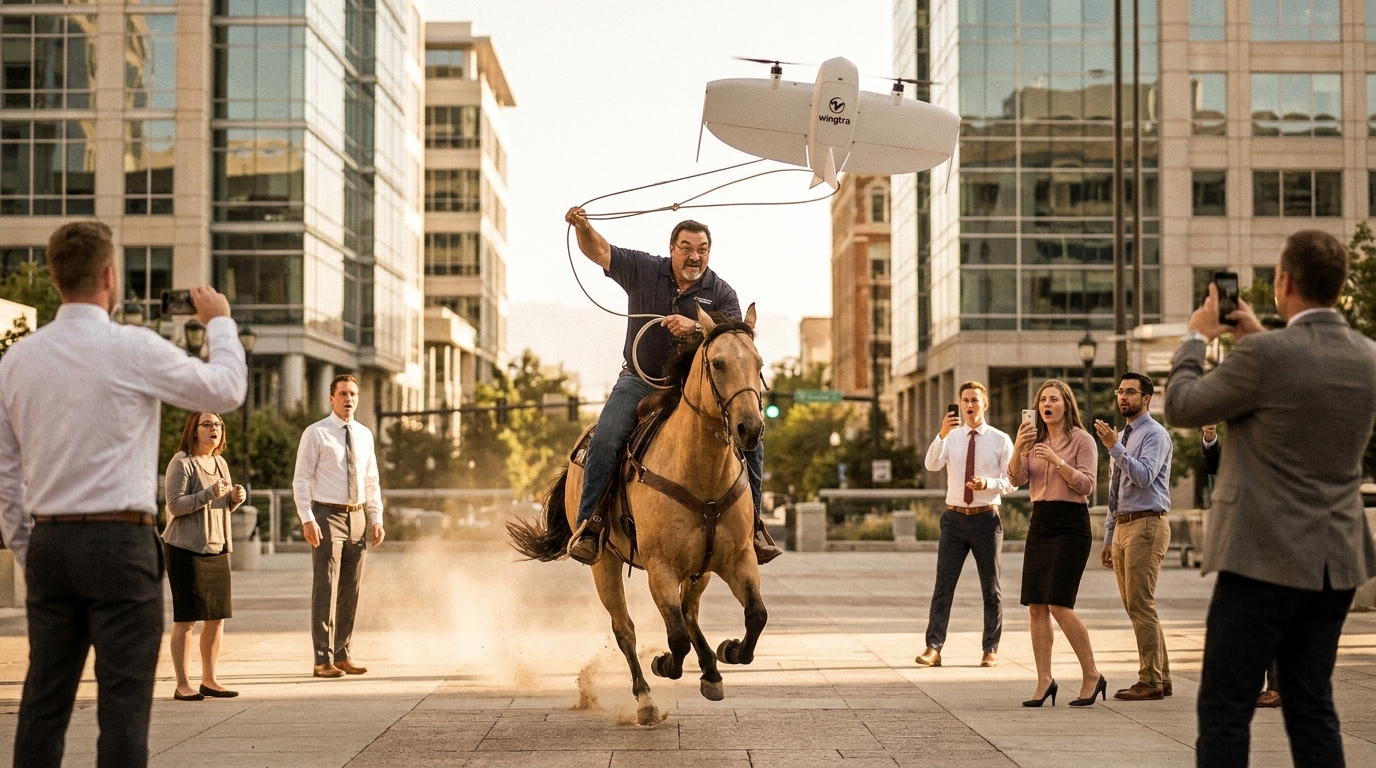
We got to the Gallivan Center about four-thirty in the afternoon. The drone was right where they said it was, slow-orbiting about thirty feet up over the plaza, big white belly pointed at the sky like a dumb fish. There was a small crowd of people on lunch break standing around staring up at it. Some of them had their phones out. Some of them were probably filming me as I rode up.
The throw was the easy part. The throw is always the easy part. Bishop and I matched the orbit at a slow canter — he stayed at exactly the drone's pace the way he always does when I'm fixed on a target. I had about a sixty-foot loop in my hand, weighted for distance. I waited for the drone to come around on the western leg of its orbit, where the wind was at my back and the buildings were behind it. I threw.
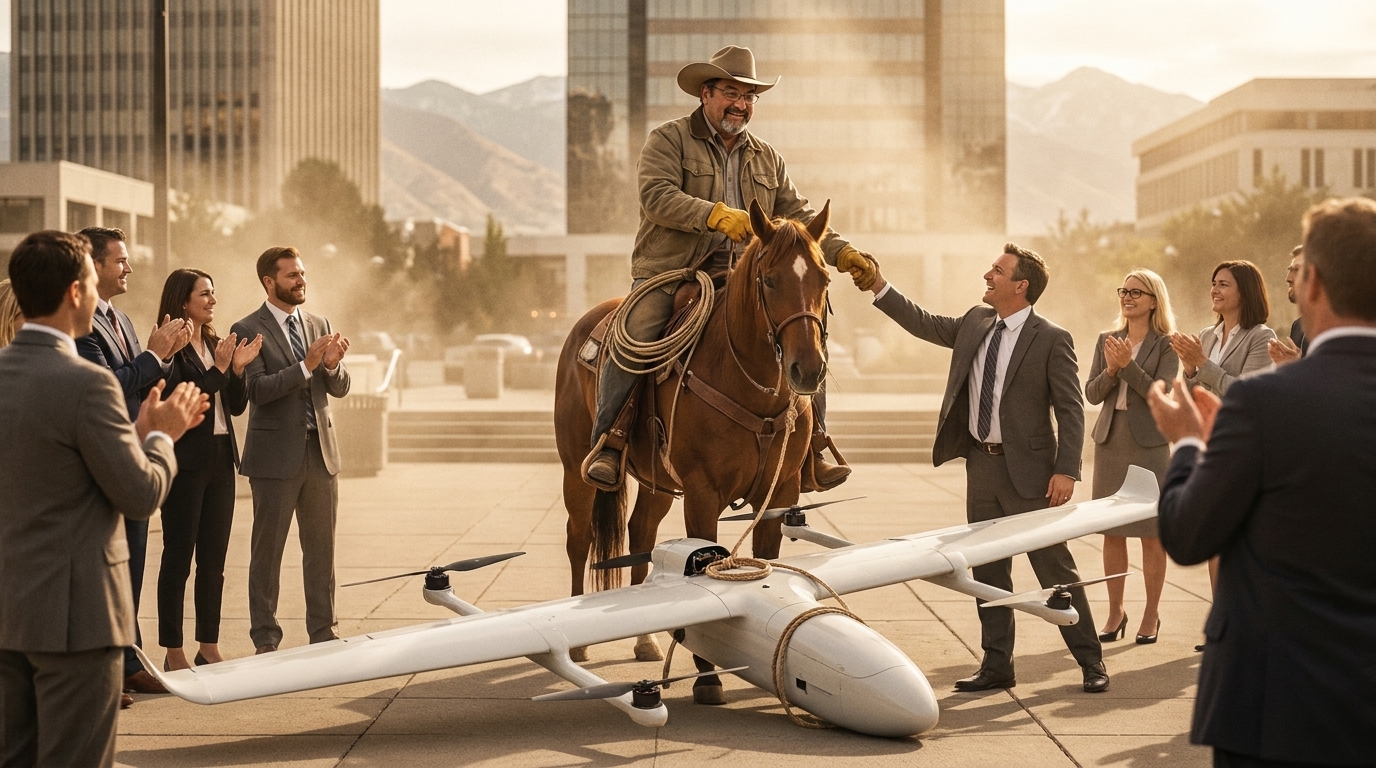
The loop went over the propeller mast and caught clean. The Wingtra is shaped almost like a small airplane, with one big motor on top and small VTOL rotors on the wings, and the lasso settled around the central motor housing with about a foot to spare. Bishop felt the line go taut and he stopped on a dime the way he was trained to stop. The drone fought it for about three seconds — its rotors spun up trying to climb against the line, which is what it's programmed to do when it senses an obstruction — and then a smarter person than me back at Wingtra HQ had built in a safety: when the bird detected sustained mechanical resistance on its airframe, it shut its props off and went into autorotation descent. It came down slow and easy on the end of my rope and landed gently on the plaza about eight feet from where I was sitting on Bishop.
The crowd applauded. I am not making that up. About forty people in business clothes on their lunch break in downtown Salt Lake City stood up off the planters and applauded. One man in a suit walked over, shook my hand, and gave me a twenty-dollar bill. I tried to give it back. He wouldn't take it. He said it was the best thing he'd seen all year. I put it in my hat band.
I packed the drone, mounted Bishop back up, and rode him back to Liberty Park at a slow walk down 200 South. The pilot from Park City met me at the trailer and paid me on the spot. Then he asked if he could take a picture with me and the bird. I said yes. He posted it on his company's Instagram. It got six thousand likes. I don't know what likes are worth, but he seemed happy.
That's the Salt Lake run. I'd do it again. I'd do it tomorrow.